Why Sarajevo’s Ottoman layers still feel lived-in
I realized Sarajevo’s Ottoman past wasn’t going to announce itself with neat plaques when I stepped off Ferhadija into the tighter lanes near Baščaršija—the materials and proportions changed, but the city didn’t “switch eras” cleanly. If you expect a museum-district feel, you’ll miss the point: the Ottoman layer here survives because people still use it, which also means you’re reading it through noise—delivery carts, café umbrellas, modern signage, and the occasional construction patch.
What helped was treating “Ottoman” as a set of recurring cues rather than a single style: narrow, curving streets that prioritize foot traffic; low rooflines and enclosed courtyards; shopfronts built for small trades instead of big retail; and religious complexes that pull daily routines (wash, pray, linger) into public space. The constraint is that later Austro-Hungarian facades sit right on top of this logic, so one pretty building doesn’t prove an Ottoman neighborhood.
For payoff, plan your first Ottoman-focused walk early (before 10:00) when the bazaar is setting up, not peak-shopping. You’ll get clearer sightlines for details, but fewer shops will be fully open—worth it if your goal is structure, not souvenirs.
Reading the old bazaar: Baščaršija’s street logic
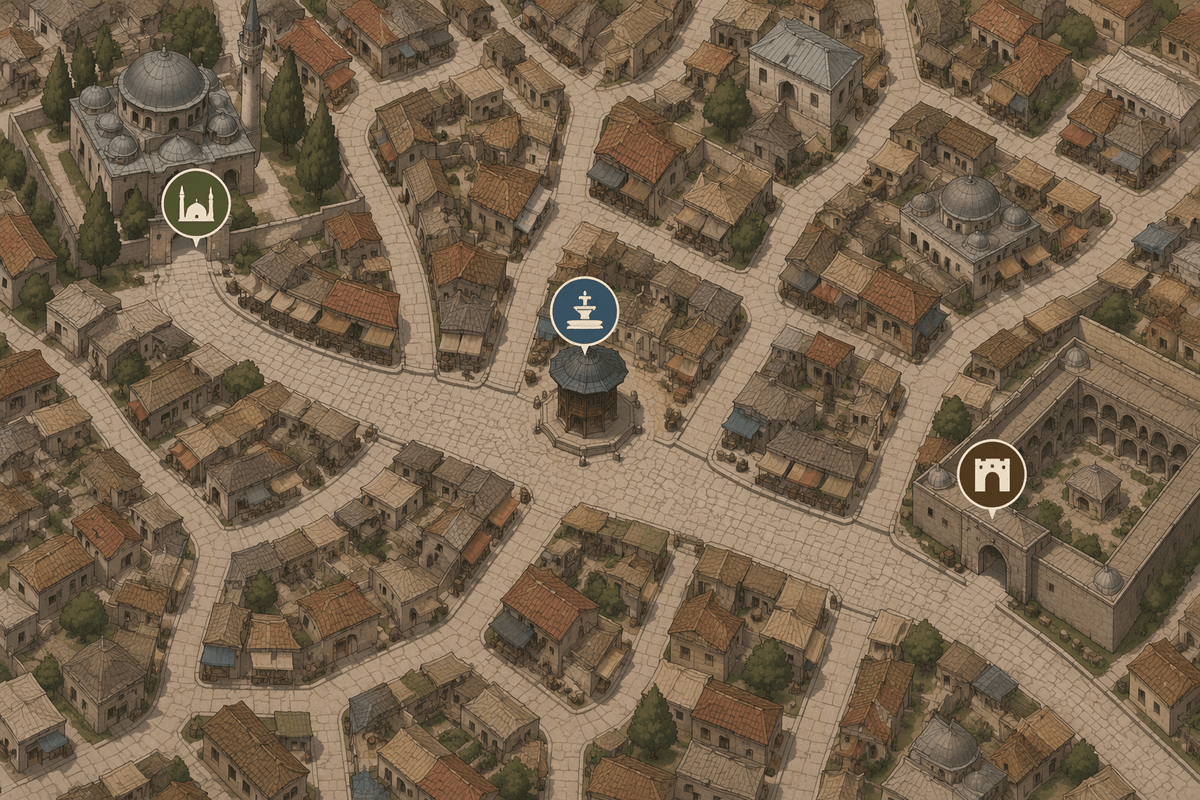
The first time I tried to “map” Baščaršija like a grid, I got impatient—Google kept telling me I was one minute away from everything, yet I was constantly funneled into bends, dead-ends, and tiny diagonals. That mild disorientation is part of the Ottoman street logic: it isn’t designed for through-traffic or grand vistas, but for short hops between work, prayer, water, and market. It works brilliantly on foot, and poorly if you’re trying to optimize a checklist.
A useful way to read it is to start at Sebilj and treat it as a hinge rather than a destination. From there, notice how the lanes tighten into “trade strands”—streets where one craft historically clustered—then widen into small pockets where you can pause without blocking flow. When it’s busy (late morning into afternoon), those pinch points turn into slow-moving knots; if you’re actually looking at lintels, eaves, and old shop proportions, you’ll do better looping back on side lanes parallel to the main spine and re-entering only when you need bearings.
What helped me separate Ottoman fabric from later layers was watching where the street asks you to behave a certain way: shoes scuffing on stone, shop thresholds only a step deep, courtyards pulling you inward. If you’re seeing wide facades, long straight sightlines, and “boulevard” logic, you’ve usually slipped into the newer city—even if the souvenir selection looks identical.
Signature buildings: mosques, hans, hammams, bridges
The moment the bazaar starts to feel like a single busy set-piece, duck into a courtyard attached to a major mosque and let your eyes reset. Gazi Husrev-beg’s complex is the clearest “Ottoman Sarajevo in one glance” because it’s not just a prayer hall—it’s a whole urban kit: courtyard, fountain, surrounding endowments, and a street edge that still behaves like a working center. It works best early, when you can hear footsteps and water instead of tour groups; by late morning, the same space can feel like a corridor of cameras, and you’ll hesitate longer about where you’re allowed to stand.
For hans, don’t expect a fortress-like monument; they read more like a practical pause in the street’s rhythm. Morića Han is the easy win because you can step inside without doing “museum logistics,” but it helps to remember what you’re looking at: an inward-facing courtyard building meant to absorb noise, animals, baggage, and negotiation—then release you back into the lanes. The friction is that modern use softens the original function, so the architecture can feel under-explained unless you actively scan for the thick walls, controlled entrances, and the way the courtyard edits the street into a calmer room.
Hammams are trickier: you often feel them more than you “see” them, because later rebuilding and repurposing can erase the obvious bathing-house silhouette. When you do find a domed, heavy-masonry volume, pause and ask yourself whether it’s a bath, a storage structure, or a later civic building borrowing the same language—Sarajevo rewards that skepticism. Then go read the bridges as a reality check: Ottoman-era crossings tend to feel like connectors between working neighborhoods rather than scenic endpoints. If you hit Latin Bridge at peak hours, it can feel like a photo stop; aim for a quieter bridge upstream or downriver to notice how the river corridor shapes movement without demanding your attention.
Daily life then and now: crafts, coffee, courtyards
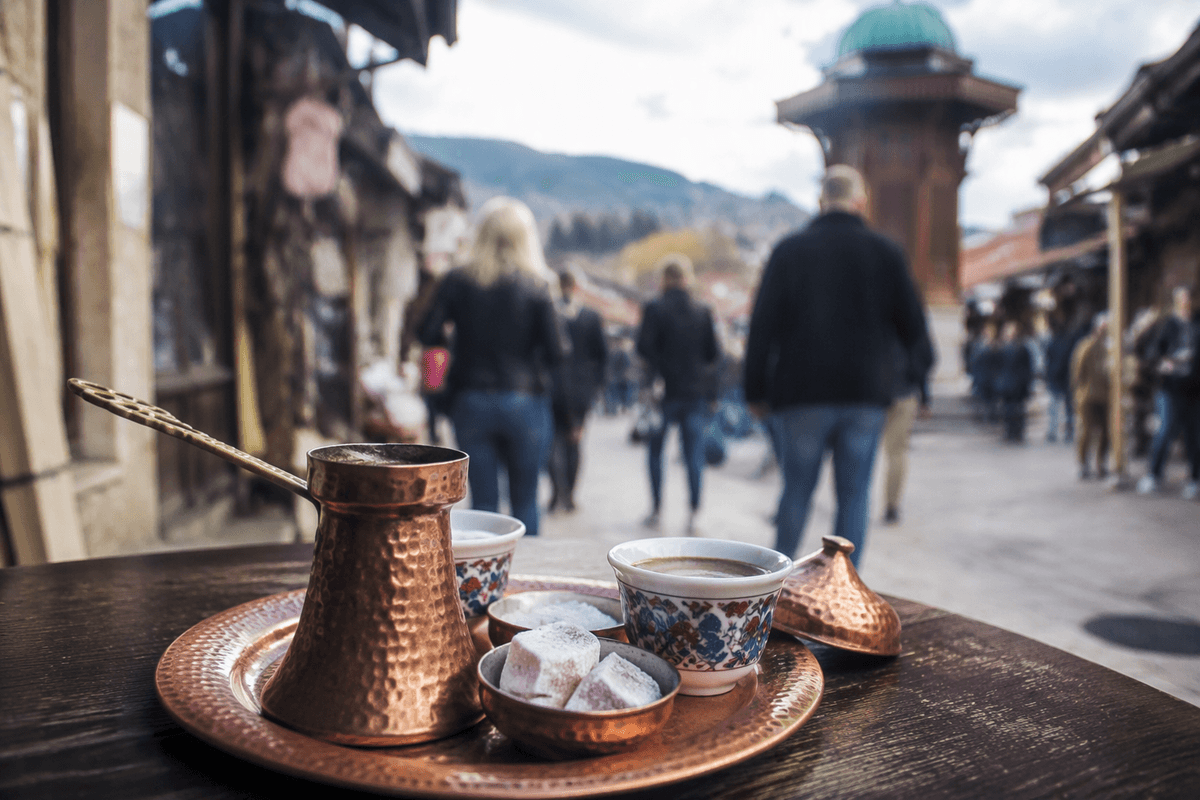
I didn’t understand Sarajevo coffee culture until I tried to “just grab one” between stops and realized it isn’t designed for speed. In Baščaršija, the good cups come with a built-in pause—cezve, rahat lokum, the little rituals—and if you fight that tempo you end up paying tourist-street prices for a rushed version that tastes fine but teaches you nothing. The better move is to pick a café slightly off the main spine, where the soundtrack is more clink than selfie-stick; you’ll lose the immediate buzz of the square, but you can actually watch the old street logic at work as people drift in and out on errands.
Craft shops are similar: the ones with the loudest displays are easiest to enter, but they often flatten the story into “Ottoman-style souvenirs.” What felt more honest was looking for workshops where the storefront is almost an afterthought—low thresholds, narrow bays, tools visible, someone actually making something. You might have to circle once or twice because opening hours can be irregular, and you may get a polite brush-off if you interrupt a task. Still, even a two-minute conversation about what’s handmade versus stamped metal is a quick way to train your eye for continuity rather than costume.
Courtyards are where the living layer snaps into focus, but they’re also where you can misstep. If a gate is open, it doesn’t automatically mean “public,” and if a courtyard is attached to a mosque complex it may switch mood around prayer times—quiet, purposeful, less tolerant of hovering. When it works, though, it’s the cleanest daily-life lesson Sarajevo offers: step out of the lane, let the sound drop, notice how walls and eaves create privacy without sealing the city off. That small spatial shift is the Ottoman inheritance you’ll feel even when the facades outside are from later centuries.
Respectful access: etiquette, timing, and photo norms
I learned the hard way that “open” doesn’t always mean “available.” A mosque courtyard can feel like a public square one minute and, five minutes later, like you’re standing in someone’s living room because a prayer time is approaching. If you’re trying to read Ottoman Sarajevo through active religious spaces, the most respectful (and honestly most productive) window is usually between prayer times: enough quiet to look at proportions, inscriptions, fountains, and thresholds, without becoming the awkward person hovering at the edge of a gathering.
Inside, the dress expectations are straightforward, but the real friction is behavioral: shoes off when required, voices down, and don’t wander past a line just because the doorway is wide. If there’s a caretaker or a small sign, treat that as your routing—Ottoman complexes were designed with controlled transitions, and ignoring them breaks the logic you came to see.
Photography is where visitors most often misread the room. Courtyards and streets are fair game, but prayer, individual faces, and shopkeepers at work deserve a pause and a question. In craft lanes, I found a quick “Can I?” plus a small purchase did more than any zoom lens; if the answer is hesitant, take it seriously and photograph the tools, doors, and street grain instead.
Leaving with a clearer eye for Ottoman Sarajevo
On my last loop out of Baščaršija, I caught myself trying to “prove” Ottoman Sarajevo with one final photo—then realized the better test was whether I could predict what came next: a bend that hides a courtyard, a pinch point where pedestrians take over, a thick-walled room that turns street noise into a hush. That’s when the mixed layers stopped feeling confusing and started feeling readable. If your eyes keep hunting domes and minarets only, you’ll miss the quieter Ottoman signatures that survive even when facades have been updated.
What stayed useful was a simple sorting habit: street logic first (curves, thresholds, courtyards), then building types (mosque complex, han, bridge), and only then surface style. It works because Sarajevo’s later layers often change what you see before they change how the place functions. The limiting factor is time—on a 3–4 day trip you can’t chase every “Ottoman” label—so pick one early morning for the bazaar’s underlying grain, and one slower window between prayer times for interiors where your attention won’t compete with crowds.
If you leave with one decision cue, let it be this: when a lane feels like it’s asking you to slow down and step carefully, you’re usually closer to the Ottoman city than you think—so stop optimizing, and start reading.