Why Antibiotics Stop Working as Reliably
The familiar pattern can change quietly. A person starts an antibiotic expecting the usual improvement, yet the fever lingers, discomfort returns, or the infection seems to settle and then reappear. That experience does not prove resistance. Recovery can be slowed by the type or location of the infection, missed doses, another illness, or the simple fact that antibiotics do not treat every cause of similar symptoms.
Resistance becomes a concern because bacteria exposed to treatment do not all respond in the same way. More sensitive bacteria may be reduced, while hardier ones survive and continue multiplying. Those survivors can remain in the body for a time or pass to other people through ordinary contact. Later, an infection involving similar bacteria may respond less predictably, sometimes requiring a different medicine or a longer course of care. Symptoms alone cannot reveal which explanation is responsible, so changes over time are useful observations—but not a reliable test by themselves.
Resistance Develops Through Survival and Selection
Under the microscope, treatment can look less like a clean reset and more like a filter. Most bacteria may be vulnerable to a particular antibiotic, while a smaller number carry traits that help them withstand it. As the vulnerable bacteria disappear, those survivors face less competition and may become a larger share of what remains. The medicine has not created a deliberate response in each bacterium; exposure has favored the ones already better able to persist.
That process can be especially difficult to notice in everyday life. Someone may improve enough to stop paying attention, yet resistant bacteria can remain without causing obvious symptoms. Repeated antibiotic exposure, close contact with other people, and shared settings such as households, schools, or care facilities can give those bacteria opportunities to move and encounter new hosts. A later illness may then be caused by something unrelated, or by bacteria with reduced sensitivity. Slow improvement and recurrence deserve attention, but only testing and clinical assessment can distinguish resistance from other reasons recovery has changed.
How Individual Use Shapes a Wider Problem

A single course can feel like a private event: one person takes the medicine, improves, and moves on. But antibiotic exposure also changes which bacteria remain in that person’s body, at least temporarily. If the medicine is unnecessary, poorly matched, or taken inconsistently, susceptible bacteria may be reduced while more tolerant ones persist. That does not mean every later illness will be resistant, and it does not make slow recovery proof of a problem. The connection is often indirect and difficult to see.
Those remaining bacteria can be carried into ordinary settings through hands, shared surfaces, household contact, or close caregiving. A child, partner, or older relative may encounter them without anyone knowing when or where transmission occurred. Repeated exposure within a household or community can increase the number of opportunities for resistant bacteria to circulate, even when each person’s treatment seemed reasonable at the time. This is why an individual prescription can influence future choices beyond the original infection. Symptoms may show that recovery is taking longer, but they cannot show whether personal antibiotic history or community spread is responsible.
When Treatment Becomes Longer Harder or Uncertain
The uncertainty often appears in small ways: a cough that remains after the worst symptoms have eased, pain that returns after a brief improvement, or a prescription that seems to take longer than expected. These changes can be frustrating, especially when a familiar infection used to respond quickly. Yet they may reflect many things besides resistance, including an infection in a difficult-to-reach area, incomplete recovery, a virus rather than bacteria, or a new infection occurring soon after the first.
When resistant bacteria are involved, treatment may become less predictable. The first medicine may not reduce symptoms as expected, testing may be needed to identify which antibiotics are likely to work, or care may involve a different drug with more side effects, added monitoring, or a longer recovery period. Even then, the symptoms are not a reliable scorecard: improvement can be uneven, and discomfort may linger after the bacteria are controlled. What matters is the pattern and the clinical context, particularly when symptoms worsen, return repeatedly, or fail to improve as expected. That uncertainty is one reason leftover antibiotics or a familiar prescription may not be a safe shortcut.
The Reasonable Action That Can Backfire
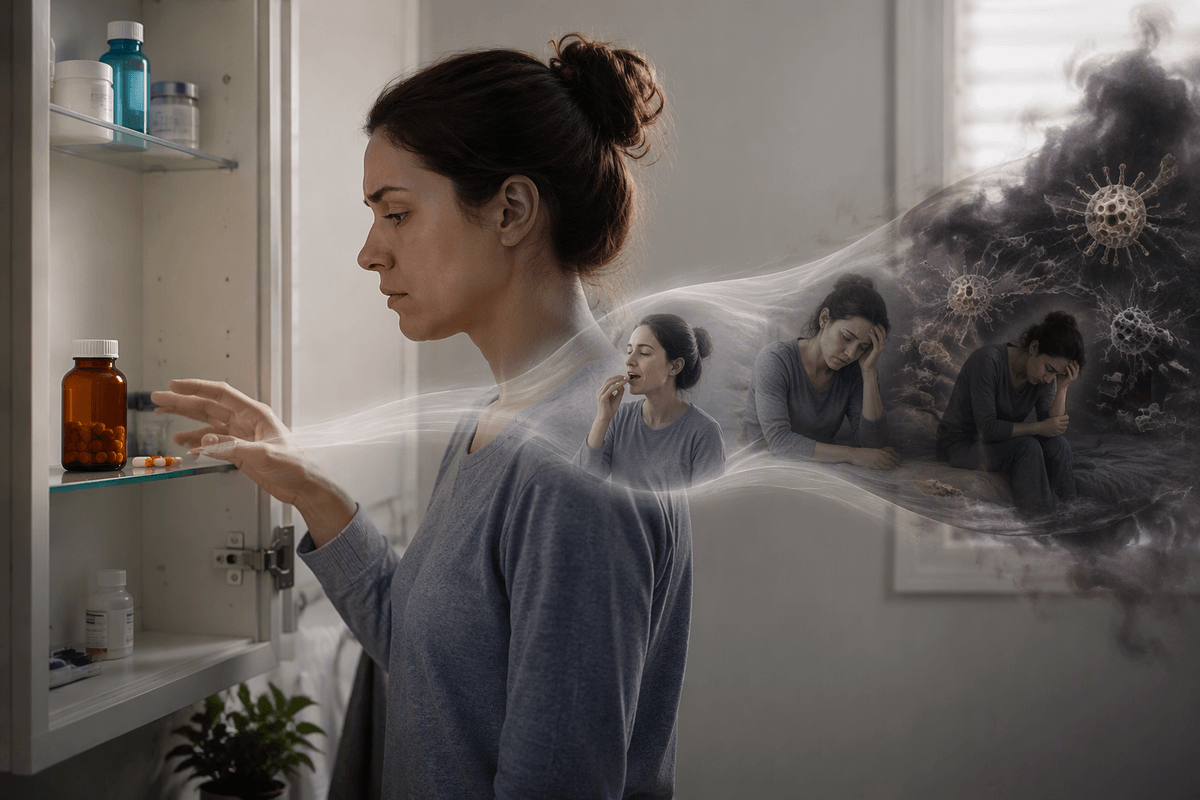
It can seem sensible to keep a familiar antibiotic on hand, use leftovers when similar symptoms return, or stop taking it once improvement begins. The reasoning is understandable: avoid a delay, avoid another appointment, and prevent a mild illness from becoming more uncomfortable. But symptoms that resemble a previous infection may have a different cause, and the same medicine may not reach the bacteria involved. An incomplete or poorly matched course can reduce susceptible bacteria without reliably clearing the infection, leaving more tolerant bacteria behind.
This shortcut can also blur what happens next. A person may feel better temporarily while the underlying problem continues, or may delay testing that would show whether an antibiotic is appropriate at all. In a household, shared medicines and repeated informal advice can extend that uncertainty to children or older relatives, whose needs may differ. Slow recovery after self-treatment still does not prove resistance, but it makes the explanation harder to sort out. The reasonable choice in one episode can therefore narrow future options when it is repeated without knowing what caused the symptoms.
Why Resistance Spreads Beyond One Infection
The next illness may begin somewhere else, in someone else. Resistant bacteria can move through hands, shared bathrooms, household surfaces, schools, workplaces, or caregiving routines, often without causing immediate symptoms. A person who carries them may feel completely well, while another person later develops an infection involving bacteria that are harder to treat. The original antibiotic course may be long finished by then, making the connection nearly impossible to notice.
Spread does not mean every contact leads to illness, and recurrence does not automatically point to transmission. The bacteria may be unrelated, or symptoms may reflect a virus, irritation, or incomplete recovery. Still, repeated antibiotic exposure and repeated close contact create more opportunities for resistant bacteria to persist and circulate. This matters in households where one person manages medicines for several generations: a treatment decision made for one infection can influence the choices available during a later infection in someone else. What appears to be a new, separate problem may sometimes carry forward part of an earlier one.
Balancing Effective Treatment With Future Protection
A later prescription can feel like a choice between treating the problem now and protecting options for the future. In practice, those aims usually support each other when treatment is based on the likely cause, taken as directed, and reassessed if recovery does not follow the expected pattern. That may mean testing before changing medicines, allowing time for a nonbacterial illness to improve, or choosing a different antibiotic when evidence points that way. None of these steps guarantees a quick recovery, and symptoms may remain even after the infection is controlled.
Future protection also depends on ordinary barriers to spread: handwashing, staying home when appropriate, and avoiding shared or leftover medicines. These actions cannot show whether resistance is present, but they reduce unnecessary exposure and limit opportunities for bacteria to circulate. A slow or recurring illness is therefore best treated as information to discuss, not proof to interpret alone. The useful balance is careful treatment now, with enough attention to preserve reasonable choices later.